
Stuck at a Laptop All Day? 6 Desk Exercises to Ease Tech Neck
 6
Mins Read
Put a hand on the back of your neck and lean toward your screen. Feel the muscles firm up. Now lean back in your chair and feel them soften. That shift is tech neck in miniature, and the tech neck exercises below are built for it: six moves you can do at your desk, starting with a two-minute band exercise researchers tested with office workers.
Here’s what’s going on. When you look down at a laptop or phone, the muscles at the back of your neck have to contract to hold your head up, and the further you look down, the harder they work, says Dr. K. Daniel Riew, a cervical spine surgeon at NewYork-Presbyterian/Weill Cornell. Keep that up all day, and they get tired and sore. He lists headaches, stiff necks, neck spasms, and pain between the shoulder blades as common complaints.
Stretching feels good when that happens. But the trials in office workers have focused on the neck, shoulder, and shoulder-blade muscles. A 2024 review of eight trials in office workers with long-term neck pain found that strengthening those muscles reduced neck pain and disability. The reviewers rated that evidence as low to very low certainty, because every trial had a high risk of bias. So it’s a reasonable bet, but the size of any benefit could turn out different.
So these tech neck exercises lean on strength.
You’ll need a light resistance band for the first two moves. The rest need only your chair. Short on time? Skip straight to number one.
You’ll also like:
- 5 Neck Stretches to Release Tension and Restore Comfort
- How To Fix Forward Head Posture: 3 Stretching Exercises to Try
- 7 Shoulder Exercises That Keep Your Arms Strong and Pain-Free After 40
1. The 2-Minute Band Lateral Raise
If you only do one thing on this list, make it this.

It’s a simple shoulder raise against a resistance band. What makes it worth your time is the study behind it.
What the study found
In one trial, researchers recruited 198 adults with frequent neck and shoulder pain, 174 women and 24 men. Some did resistance training with elastic tubing for 2 minutes a day, five days a week. Some did 12 minutes. A control group got weekly general health information instead.
After 10 weeks, neck and shoulder pain in the two-minute group had dropped 1.4 points on a 0 to 10 scale compared with the control group. Muscle tenderness fell too. The 12-minute group improved slightly more, but the difference between the two training groups wasn’t significant.
According to EHS Today’s coverage of the study, the exercise was a lateral raise with the arm slightly in front of the body, using elastic tubing with handles. The study’s abstract describes the training as progressive, meaning it got harder over the 10 weeks.
There was a bonus finding. A follow-up analysis of the same trial, which described participants as office workers, found that headache frequency in the two-minute group fell by 0.64 days a week compared with the control group. The researchers put that at a 43% drop from where it started. The headaches that remained weren’t any shorter or less intense, though.
How to do it
The study’s exact setup isn’t described in its abstract, so this is a common way to do the move at a desk.

- Sit tall near the front of your chair, or stand beside your desk.
- Step on one end of the band with the foot on your working side. Hold the other end in that hand, arm by your side.
- Raise your arm out to the side and slightly forward until it’s about level with your shoulder.
- Lower it slowly. Don’t let the band snap your arm down.
- Keep your shoulder down, away from your ear, the whole time.
Switch arms as you go and keep moving for about two minutes. Pick a band light enough that your last reps look as clean as your first.
How to build on it
The training in the trial was progressive. Once two minutes feels easy, add a few reps or move to a firmer band. Small steps.
And give it time. The study ran for 10 weeks, so treat this as a daily habit rather than a quick fix for today’s stiffness.
A second trial from the same research group looked at timing. It assigned 447 office workers to one hour a week of supervised, high-intensity strength training for 20 weeks, or to no training. Among those who started with notable neck pain, all three schedules reduced it: one 60-minute session, three 20-minute sessions, or nine 7-minute sessions. That was a different program from the band raise, and still a full hour a week. But it suggests shorter sessions can add up.
2. Band Pull-Apart
Same band, different job.
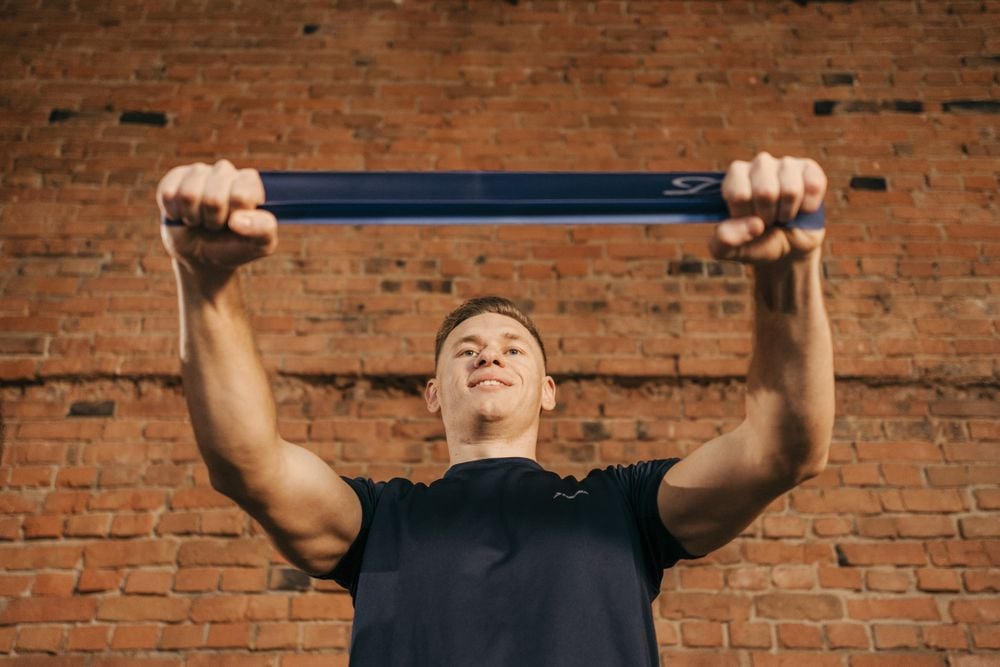
Sitting hunched at a laptop lets your shoulders drift forward. The pull-apart has you draw them back and squeeze your shoulder blades together, the opposite of that hunch.
How to do it: Hold the band in front of your chest with both hands, arms straight and hands about shoulder-width apart. Pull your hands out to the sides until the band touches your chest, squeezing your shoulder blades together. Return slowly. Keep your neck long and your chin level throughout.
3. Hand-Resisted Neck Press
No equipment for this one. Your hands provide the resistance.

Dr. Riew recommends this move to strengthen the extensor muscles at the back of your neck, the same ones that work overtime when you look down. Link your hands behind your head and press your head back into them, holding for a few seconds. He suggests 5 to 10 reps for every hour you spend looking down.
Keep the pressure gentle. Riew warns against overdoing it, because over-strengthening can lead to neck problems later in life. Of all the tech neck exercises here, this is the easiest to sneak in between emails.
4. Headrest Chin Nod
Sit back so your head rests against your chair’s headrest or a high chair back. A wall works too.

Gently nod your chin down, as if making a very small “yes,” and let the back of your head slide up the headrest. Your head shouldn’t push forward or tip down toward your chest. Hold for a breath or two, then relax.
It’s a gentle way to practise holding your head back over your shoulders instead of out in front of them. It’s the most subtle of these tech neck exercises. If you feel the big muscles at the front of your neck straining, you’re working too hard. Ease off.
5. Chair-Back Upper Back Extension
Tech neck doesn’t stop at the neck. The upper back rounds forward with it.

How to do it: Sit in a stable chair, not one that rolls or reclines suddenly. Shuffle forward so the top of the chair back sits just below your shoulder blades. Support your head with your hands behind it, elbows pointing forward. Lean back gently over the chair back, letting your chest lift, and your gaze rise toward the ceiling. Return to upright.
That upward gaze is worth a habit of its own. Riew suggests lifting your head to look up every 10 to 15 minutes, to help reverse all the time spent looking down.
Skip this move if you have a known neck or back problem. If leaning back brings on pain, tingling, or dizziness, stop and sit upright.
6. The Back-Pocket Shoulder Slide
This is the quickest move on the list, and a good way to start each of the others.

Imagine sliding your shoulder blades down and slightly back, into your back pockets. Hold for a couple of breaths. Let go.
Do it before each of the tech neck exercises above, as a reminder to bring your shoulders down from your ears. It also works as a quick reset in the middle of a meeting, when nobody’s watching.
Final Thoughts
If you pick one move, make it the band raise, two minutes a day on workdays, which is the schedule the trial tested. Results were measured after 10 weeks, so give it that long before you judge it. Pair your tech neck exercises with a better setup: Riew suggests a chair reclined 25 to 30 degrees with good lumbar support, and getting up to walk around every 15 to 30 minutes, even for a minute.
These moves are for everyday stiffness and soreness. If your neck pain comes with numbness, tingling, or weakness in your arms, follows an injury, or keeps getting worse, see a doctor or physical therapist before you start. The same goes if you already have a diagnosed neck or shoulder condition. A professional can tell you which moves suit you and which to skip.


